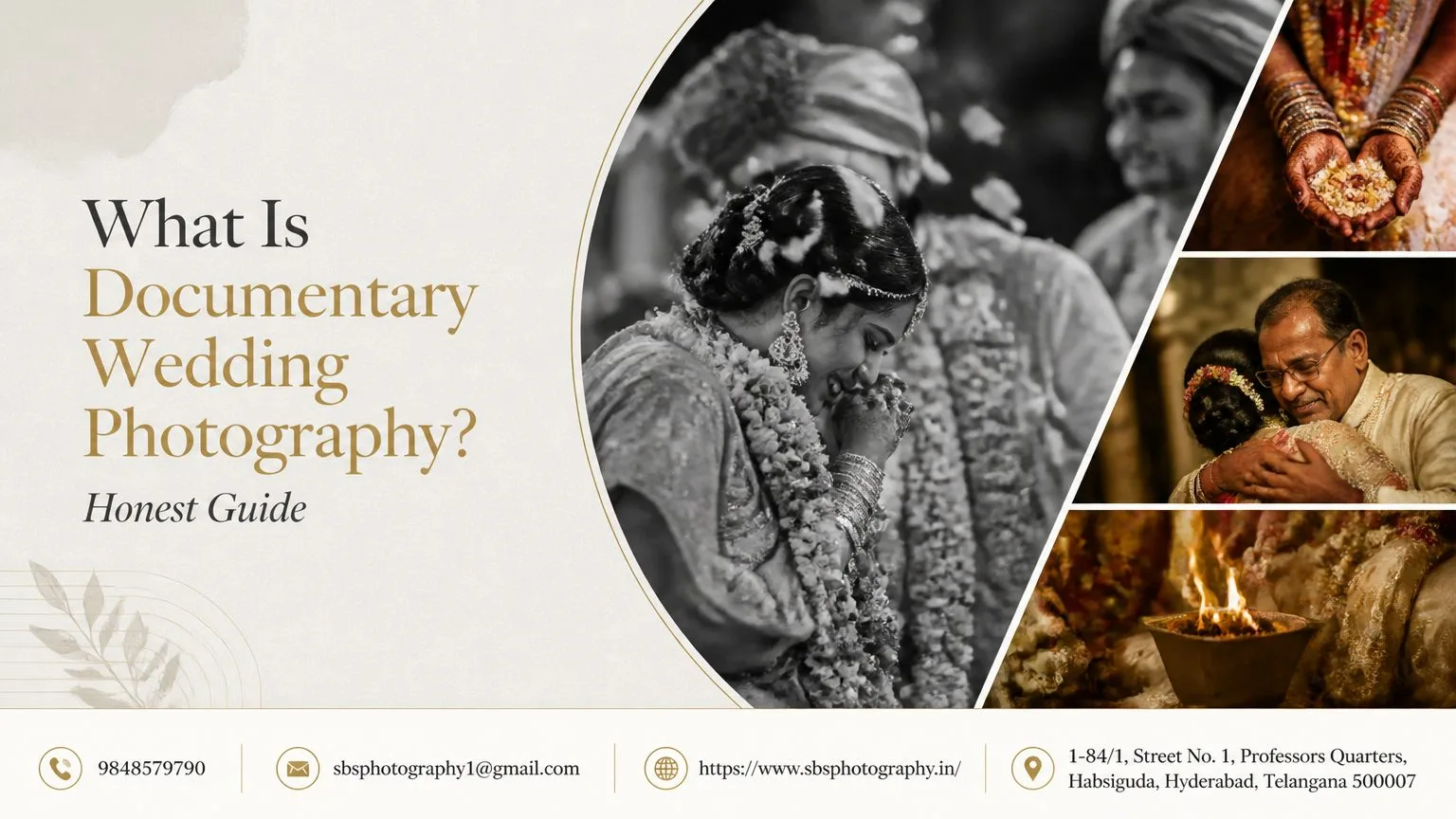
Overview
Your wedding day will unfold in hours. The quiet tear during the varmala, the laughter when someone loses a step, the look your mother gives as the baraat arrives — those moments are gone the instant they happen. That is exactly why more and more couples are leaving stiff, posed photography behind and choosing something far more honest.
Documentary wedding photography captures the day as it unfolds — without asking you to pause, pose, or repeat a single moment. It is photography that trusts the story you are already living. In this guide, we will break down what documentary wedding photography actually means, how it differs from the traditional posed approach, what it looks like across Hyderabad's diverse wedding ceremonies, and why this style now leads the global wedding industry.
TL;DR / Quick Answer
Documentary wedding photography is an unposed, story-driven approach where the photographer captures real moments as they happen — rituals, tears, laughter, and quiet glances — without directing or interrupting the natural flow of your day. Instead of staging scenes, the photographer simply observes and records. Couples today increasingly prefer candid or mixed coverage over purely traditional posed shots, which is why the documentary approach has become so popular.
What Is Documentary Wedding Photography?
Documentary wedding photography, sometimes called photojournalistic or candid wedding photography, is a style built on one principle: capture what actually happens. No posing. No staging. No "turn to the camera and smile." The photographer moves through the day as an observer — reading the room, anticipating emotions, and pressing the shutter at the exact moment something real unfolds. The approach borrows from news photojournalism: tell the truth, interfere as little as possible, and let the story reveal itself. Over the past decade, that foundation has evolved into something warmer. Modern documentary wedding photographers actively read light, notice the subtle emotional currents between people, and compose each frame with care — all without ever asking you to stop, repeat, or reconstruct a moment that has already passed.
At its core, this style is about mutual trust. The photographer trusts that your wedding day, completely unscripted, already has everything worth capturing. You trust the photographer to be present and skilled enough to find those fleeting moments before they vanish. One couple, reflecting on the experience with About SBS Photography, described it simply: "The photographs felt like memory, not performance." If you are exploring your options for a wedding photographer in Hyderabad, this philosophy should guide the decision more than any pricing sheet or highlight reel. It shapes every choice — from the lenses the photographer carries to where they position themselves during the varmala to what they include in your final gallery.
Documentary vs. Traditional Wedding Photography
The clearest way to understand documentary wedding photography is to see what it replaces. Traditional wedding photography revolves around a shot list. The photographer tells you where to stand, how to angle your chin, and when to smile. Group photos, posed couple portraits, and arranged ceremonial stills are all constructed moments — polished and predictable, yes, but fundamentally performed rather than lived. Documentary wedding photography operates on the opposite principle. The photographer becomes nearly invisible, moving through the ceremony and reception without pulling attention or pausing the action. Rather than orchestrating scenes, they read and respond to whatever is actually happening. The result is a gallery built from real reactions, genuine emotion, and moments no shot list could have predicted.
Most documentary photographers still reserve time for a small number of family group portraits and a few editorial couple frames — — but these are kept few, so the gallery stays mostly unscripted. For couples deciding between the two approaches, the core question is straightforward: do you want images that look like you performed your wedding day, or images that feel like you lived it? Studios like SBS Photography, which works with a documentary heart and an editorial eye, blend both worlds — honest candids captured alongside beautiful, intentionally composed portraits — so you never have to choose between authenticity and visual quality on the most important day of your life together.
What Does a Documentary Wedding Photographer Actually Capture?
Documentary coverage begins well before the ceremony starts. During the getting-ready hours, a documentary photographer captures what a posed setup cannot: the father standing quietly in the hallway, the nervous adjustment of a dupatta, the shared laughter in the bridal suite that no studio direction could reproduce. The ceremony is where the style shows its real strength — the expression on the groom's face when the bride first appears, the exact instant the mangalsutra is tied, the whispered remark between siblings during the pheras. These moments exist for seconds and never return. A photographer trained in documentary work is already positioned, already reading the light, already waiting for that precise instant.
Beyond the ceremony, the documentary lens never switches off. Family members wiping their eyes during the vidai, cousins sharing a private joke after the rituals, the grandmother watching quietly from a corner — these connective-tissue moments are often the ones couples treasure most years later. For documentary-style wedding coverage in Hyderabad, haldi ceremonies are especially vivid: turmeric-smeared faces, someone inevitably getting splashed or pushed into the crowd, uncontrollable laughter spreading through the room — energy that cannot be staged or repeated. The reception brings its own distinct rhythm: the toast that makes the entire room fall silent, the first dance, the friend who channels unexpected emotion on the dance floor. A documentary photographer does not just cover the headline moments. They document everything in between — the accidental beauty, the things you were too busy living to notice.
Why Documentary Photography Is Dominating Weddings in 2026
More couples now ask for honest, unposed coverage of their wedding day. Searches and conversations around candid and cinematic wedding photography keep growing, and many couples specifically request that guests keep phones away during the ceremony so the gallery stays clean and distraction-free. Documentary coverage fits this shift naturally: it records the day as it actually felt, not as it was staged.
The approach also pairs well with wedding films. Photographs preserve how the day looked; films preserve how it sounded and moved. Together they tell the complete story of the celebration.
Does Documentary Photography Work for South Indian and Hyderabadi Weddings?
A concern couples raise frequently: "Our wedding involves very specific rituals — will a documentary photographer miss the critical moments?" The honest answer depends on the photographer's cultural fluency, not the style itself. Documentary wedding photography is perfectly suited to traditional Indian ceremonies. The approach only falters when the photographer does not understand what is about to happen. Consider a Telugu wedding: the Jeelakarra Bellam ritual, where the bride and groom simultaneously place a paste on each other's foreheads. The Talambralu shower of turmeric rice over the couple. The exact instant the mangalsutra is tied while the nadaswaram fills the mandapam. These are moments built on genuine surprise, tenderness, and spontaneous laughter — moments that are always more powerful when captured as they actually happen.
The same logic holds for Hyderabadi Muslim weddings. The Arsi Mushaf moment — when the groom first glimpses the bride's reflection through a small mirror — carries real, irreproducible emotional weight. The signing of the Nikahnama. The collective stillness during the Dua. No pose can replicate the emotional intensity of those actual instants. What separates a strong documentary photographer from a mediocre one is whether they understand the ceremony well enough to anticipate it. Cultural fluency means knowing that the Jeelakarra Bellam is about to happen and positioning yourself before it does. It means understanding when during the Nikah the groom will read the Quran, and not standing where equipment will block a critical angle. This is where deep familiarity with Hyderabad's wedding traditions turns a general photographic philosophy into a gallery that feels completely, honestly true.
Documentary Wedding Films: Beyond Still Photography
A photograph freezes a shape, a face, a falling light. A wedding film captures what a still frame never can — the rhythm of the baraat drums from a distance, the bride's nervous laugh as her father walks her in, the exact sound of a grandmother's whispered blessing in Telugu. This is why documentary wedding photography is increasingly paired with wedding filmmaking. Photographs preserve how the day looked; films preserve how the day felt. Many couples now request an unplugged ceremony, asking guests to put phones away, which preserves the film free of background screens and ensures cleaner, undistracted footage of the actual events.
Documentary wedding films build their narrative from real recorded audio, genuine ambient sound, and authentic pacing — no scripted voiceover, no cinematic formula applied from the outside. A typical film might open with the quiet hum of morning preparation, build through the ceremony's emotional intensity, peak during the reception's energy, and close with the couple walking out into the night, entirely themselves. Having one studio handle both stills and film creates a consistency that two separate vendors rarely achieve. Wedding films with sound, motion and atmosphere from SBS Photography are produced by the same team that shoots the stills, preserving one visual language, one editorial instinct, and one storytelling rhythm across both formats. Ask yourself this: twenty years from now, would you rather see a photograph of your mother blessing you, or relive the actual moment with her voice still clear in your ears?
Questions to Ask Before Hiring a Documentary Wedding Photographer
Once you have shortlisted a photographer whose portfolio resonates, the pre-booking conversation is where real decisions are made. Start with the non-negotiable: "Can I see a complete wedding gallery from a single event — not a curated Highlights reel?" Highlights show you the best moments; a full gallery reveals consistency, the low-light frames, the difficult angles, and the overall standard across an entire day. Ask how the photographer handles low-light indoor ceremonies, which are common across Hyderabad's kalyana mandapams and hotel ballrooms. Inquire about their approach to family group portraits: are they taken quickly and woven into the day's flow, or do they dominate half an hour and pull everyone away from the celebration?
If you are booking the photography and video teams from different vendors, ask how the two crews will coordinate on the day. Two uncoordinated teams fighting for the same angle means blocked shots and permanently missed moments. Clarify what happens when an event runs longer than expected — good overtime clauses protect you from surprise charges and protect the photographer from unmanaged scope creep. Finally, confirm who exactly is shooting your wedding: insist that the lead photographer named in the contract is the person who shows up, not someone from a wider studio roster. Before making a final decision, reach out through the Contact SBS Photography page and have an honest conversation about your timeline and vision. An informed discussion before booking can reveal more about a photographer's approach and care than any portfolio alone.
Conclusion
Documentary wedding photography is not a passing aesthetic — it is a fundamental shift in how couples choose to remember their weddings. More couples now prefer candid or mixed coverage over purely posed photography. The philosophy is simple: the photographer trusts your wedding day to be real, unscripted, and worth capturing exactly as it was — and you trust them to see it clearly and honestly.
If that is the kind of storytelling you want for your wedding day — honest, beautiful, and rooted in what actually happened rather than what was staged — you can Book your wedding date with SBS Photography and begin the conversation about how your day deserves to be remembered.
Frequently Asked Questions
What is documentary wedding photography?
Documentary wedding photography is an unposed, story-driven approach where the photographer captures real moments as they happen — rituals, emotions, family interactions — without directing or interrupting the natural flow of your wedding day. It treats your wedding as a living story rather than a staged photoshoot.
How is documentary wedding photography different from candid photography?
The terms are often used interchangeably, but documentary photography is a broader, more intentional approach. It covers the full day as a continuous narrative with deliberate composition and emotional consistency, while candid photography can refer to isolated unposed moments without the same storytelling structure.
Does documentary wedding photography include any posed portraits?
Most documentary photographers include a small number of family group photos and a few editorial couple portraits. The bulk of the gallery still consists of unscripted, spontaneous moments captured throughout the day.
Is documentary photography suitable for traditional Telugu and Hyderabadi Muslim weddings?
Yes. Telugu rituals like the Jeelakarra Bellam and Talambralu, along with Hyderabadi Muslim ceremonies like the Arsi Mushaf and Nikah, naturally produce powerful unscripted moments. A culturally fluent documentary photographer captures these events far more authentically than a posed approach ever could.
How much does documentary wedding photography cost in Hyderabad?
Pricing depends on coverage duration, team size, venue, and whether wedding films are included. Rather than relying on published estimates that may go out of date, it is best to request a tailored quote based on your specific wedding dates and requirements.
What should I look for when choosing a documentary wedding photographer?
Request a complete gallery from a single wedding rather than judging by highlights alone. Look for emotional authenticity, technical consistency in low-light conditions, visual coherence, and strong reception coverage. Cultural fluency with your specific ceremony type is equally important.
Should I book wedding films alongside documentary photography?
Yes, if you want to relive the sounds, voices, and atmosphere of your wedding day. Photographs preserve how the day looked; films preserve how it felt. Booking both from a single studio ensures visual and narrative consistency across formats.