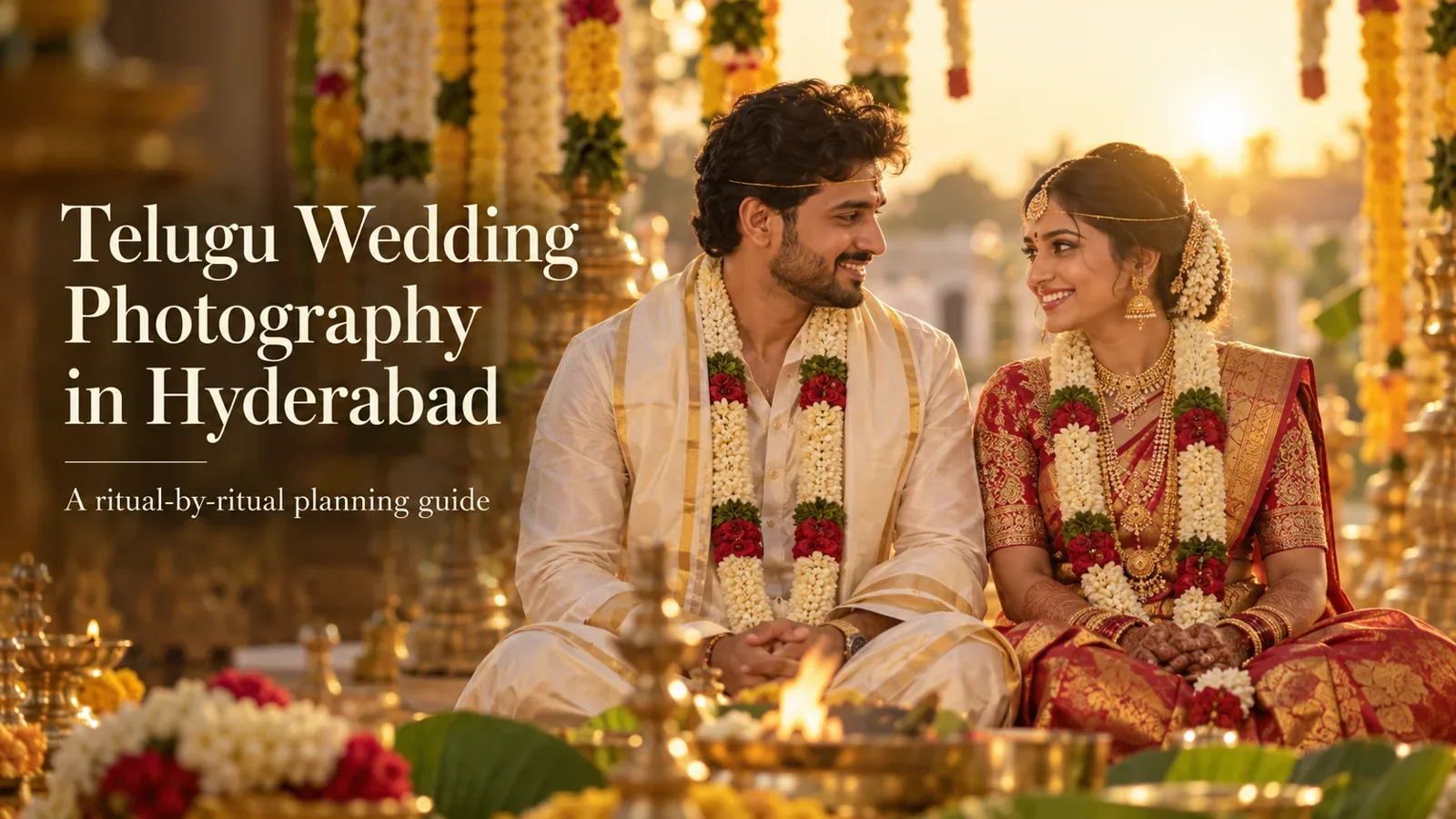
Quick answer: a Telugu wedding in Hyderabad has several rituals that happen at set moments, often tied to an auspicious time, so the best photography plan starts with a ritual list. Share the sequence with your photographer early, mark the moments that cannot be repeated, such as the jeelakarra bellam, the talambralu and the mangalsutra dharana, and decide who will guide the photographer through the family groups. Rituals vary between families, so confirm the details with your elders and priest before you build the plan.
Why a ritual-led plan works for Telugu weddings
Many couples plan photography by the clock: arrival, ceremony, portraits, reception. In a Telugu wedding, it often makes more sense to plan by the ritual. Each ritual has its own mood, its own people at the centre and, in some cases, its own fixed time. If the photographer knows what is happening, who is involved and when the key moment arrives, the pictures tend to look calmer and more natural, because nobody has to be hurried or asked to repeat something that has already passed.
This guide goes through the common stages of a Telugu wedding in Hyderabad from a photographer's point of view. It is general information. Every family follows its own customs, some rituals are shortened or reordered, and the venue and priest decide a lot. Treat this as a conversation starter with your photographer, not a fixed script.
Before the wedding: pellikuthuru and the early rituals
What happens
In many families, the days before the wedding begin with rituals at the homes of the bride and the groom, often including a turmeric ceremony and an oil or bathing ritual known as mangala snanam. Elders, aunts and cousins take part, and the atmosphere is playful and warm. Families may also hold a Ganesh puja and other prayers to begin the celebrations.
What good photography looks for
- Close, unposed moments between the person being celebrated and the women of the family.
- Details such as turmeric, flowers, brass vessels, traditional clothes and jewellery.
- Gestures of blessing from grandparents and elders.
Practical tips
- Wear clothes you do not mind getting stained, and tell your photographer if you want a few portraits before the turmeric.
- Keep the space as clear as you can so the photographer can move around.
- Choose one family member to point out relatives who should be photographed with you.
Engagement and the sharing of families
Some families hold a formal engagement before the wedding, where rings or gifts are exchanged and the two families meet in a more structured way. This is a good time to take clean portraits of the couple and the family groups, since people are dressed up and often more relaxed than on the wedding day. If your engagement is a separate event, ask whether the same photographer can cover it, so the story starts early and the faces of the family become familiar to the photographer before the main day.
Wedding day: arrival and the first moments
Wedding day coverage often begins with the preparation of the bride and the groom, followed by the arrival of the groom's party and the welcome by the bride's family. These early hours are less crowded and often produce some of the most honest pictures: a mother adjusting a sari pleat, a father looking at his child before the ceremony, friends laughing in the corridor.
- Getting ready: give the photographer a quiet corner with good light, ideally near a window.
- Details: lay out jewellery, flowers, invitation cards, shoes and any family heirlooms in one place before the photographer arrives.
- Welcome: tell the photographer who will receive the groom's party and where it will take place.
Kasi yatra and the playful moments
In many Telugu weddings, the groom performs a symbolic ritual known as Kasi yatra, where he sets out as if leaving for pilgrimage and the bride's family persuades him to return and marry. It is a light-hearted moment, full of expression, and it is easy for photographers to miss if they have not been told it is coming. If your family includes it, let the photographer know where it will happen and who will take part.
The central rituals: where timing matters most
The main ceremony often includes a series of rituals that follow an auspicious time chosen by the priest, usually called the muhurtham. The exact order depends on the family and the priest, but photographers commonly plan for these moments.
Jeelakarra bellam
In many weddings, the bride and groom place a paste of cumin and jaggery on each other's heads at the chosen time. It is a small gesture that carries meaning for the families. It happens quickly and is hard to repeat, so the photographer should be close and ready. Tell them the approximate time and where the couple will be seated.
Talambralu
The couple pour rice, often mixed with other items, over each other's heads while family and friends cheer. It is lively, joyful and colourful. Photographers usually look for expressions, hands and the reaction of relatives. To help, keep the area around the couple free of too many people during this ritual.
Mangalsutra dharana
The tying of the mangalsutra is a deeply emotional moment for many families. Ask the priest how the sequence will go and where the photographer may stand without blocking the guests' view. Agree on this before the day, so nobody has to negotiate during the ceremony.
Saptapadi and other rites
Walking the seven steps together and other rites that follow give the photographer the chance to capture movement, feet, hands and the couple's expressions. If the ceremony includes a pause or a break, plan portraits for that time instead of interrupting a ritual.
Arundhati nakshatram and the closing rituals
Some families include the ritual of showing the star Arundhati to the couple, along with other closing rites. Whether it appears depends on the family and the time of the ceremony. Ask your priest what will be included so the photographer can plan accordingly.
After the ceremony: portraits and family groups
Once the main rituals are over, there is usually a window for couple portraits and family photographs. This is where a short list helps. Write down the groups you want, such as each side of the family, siblings with the couple, grandparents with the couple and close friends. Ask one confident relative on each side to gather people so the photographer can work quickly.
- Keep the list short. A very long list can take a lot of time and tire everyone.
- Take the elders first. They may need to sit or rest, and they are often the most important photographs.
- Plan the couple's portraits separately. A few quiet minutes away from the crowd can give you calmer pictures.
The send-off and the quiet end of the day
Many weddings end with the bride leaving her parents' home, sometimes after a ritual that includes blessings and gifts from the family. It is an emotional moment, and photographers often look for faces rather than formal poses. If you want a particular picture, such as the couple with the bride's parents, mention it beforehand.
Light, space and venue questions for Hyderabad weddings
Hyderabad weddings take place in function halls, banquet halls, temples, gardens, resorts and homes. Each has its own light and space challenges. Ask your photographer to visit the venue if possible, and think through these questions.
- Is the main ceremony in a covered or open space, and how is it lit?
- Where will the guests sit, and will the photographer have room to move?
- Is there a quiet area for portraits and for getting ready?
- Are there rules at the venue or temple about photography or filming?
- What is the plan if it rains or the schedule changes?
Photographs and film together
Many couples choose both photography and film. When both are planned together, the team can coordinate positions during key rituals so that neither blocks the other. Ask the studio how photographers and videographers work together during the ceremony and whether the team will rehearse the sequence with the priest or the family.
How to share the plan with your photographer
- Write down the sequence. List each ritual with its expected time and location.
- Mark the key moments. Highlight the ones that cannot be repeated.
- Name your guides. Choose one person per side of the family to help with groups.
- Share the venue details. Include the address, hall number, parking and contact person.
- Talk about style. Say whether you prefer candid, traditional or a mix, and share examples you like.
- Confirm after the priest. Check the final timing with your priest, then update the photographer.
Questions to ask your photographer
- Have you photographed Telugu weddings, and how do you plan for the key rituals?
- How many people will be on the team, and who covers which part of the day?
- How do you work with the priest and the family during the ceremony?
- How do you handle low light, crowded halls and last-minute changes?
- When and how will we receive the pictures, and what happens if we want a particular photo?
Common mistakes to avoid
- Not sharing the ritual list. A photographer who does not know what is coming may miss it.
- Overloading the family group list. A long list can use up valuable portrait time.
- Letting too many people crowd the couple. Many relatives with phones can block the view.
- Skipping a conversation with the priest. The priest decides timing and positions during the ceremony.
- Leaving portraits until the end. People tire, light changes and moods shift. Plan a short portrait window earlier.
A simple planning checklist
- Ritual list with times and places.
- Key moments marked for the photographer.
- Family group list, with one guide per side.
- Venue visit or venue details shared.
- Plan for portraits and breaks.
- Agreement on photo and film coordination.
- Delivery timeline and format confirmed in writing.
How SBS Photography can help
SBS Photography is a wedding photography and film studio based in Hyderabad. Its website lists photography for Telugu weddings and other traditions, as well as pre-wedding shoots, portraits and events. The studio describes its approach as documentary in spirit with an editorial eye, focused on real gestures and the atmosphere around the people you love. If you are planning a Telugu wedding, you can read more about the studio on its website, look at earlier guides such as haldi, mehendi and sangeet photography in Hyderabad and editorial wedding photography in Hyderabad, and get in touch through the contact page to talk about your plans.
Frequently asked questions
Do all Telugu weddings follow the same rituals?
No. Families follow different customs, and the order and length of rituals can change. Confirm your plan with your elders and priest.
Which Telugu wedding moments are the hardest to photograph?
Quick, one-time moments, such as the jeelakarra bellam and the mangalsutra dharana, are often the hardest because there is little chance to repeat them. Tell your photographer when they will happen.
Should the photographer talk to the priest?
It can help. The priest knows the sequence and where people will stand, and the photographer can ask where they may position themselves.
How many family groups should I plan?
Keep the list manageable. Focus on key groups, such as immediate family, grandparents and close friends, and ask for a few extra if time allows.
Can the same team cover the pre-wedding events and the wedding?
Many studios can. It can help the gallery feel like one story. Ask about team size and how coverage is planned across the days.
What if the ceremony timing changes?
Ask the photographer how they handle schedule changes, and share any changes as soon as the priest confirms them.
Is it better to have photographers and videographers from the same studio?
It can make coordination easier, since one team plans positions together. It depends on your preference, so ask the studio how it works.
How early should I book a wedding photographer in Hyderabad?
Popular dates can fill up, so it is sensible to start the conversation as soon as you have your dates. Confirm availability directly with the studio.
What should I wear for photos at a Telugu wedding?
Wear what feels right for the ritual and the season. Comfortable clothes and footwear help you stay relaxed through a long day.
This article is general information to help you plan. Customs and approaches differ between families and photographers, so confirm the details with your priest, family and chosen studio.